Discover your lower dan tien, the body's core energy center. Learn its location, function, & breathing exercises for balance, stability, & vitality.
May 1, 2026 (Today)
Unlock the Power of Your Lower Dan Tien
Discover your lower dan tien, the body's core energy center. Learn its location, function, & breathing exercises for balance, stability, & vitality.
← Back to blog
Individuals often come to the idea of the lower dan tien when something already feels off. You’re thinking too much, sleeping lightly, reacting quickly, and walking around as if your attention lives somewhere above your shoulders. Your body is present, but you don’t quite feel at home in it.
That scattered feeling is common. In Qigong, Tai Chi, and internal martial arts, the answer isn’t to force more focus with the mind alone. It’s to return attention to the lower body and rebuild a sense of center. That center is what many traditions call the lower dan tien.
I teach it as a practical anchor, not an abstract mystery. When people begin to feel it, they often describe warmth in the belly, heavier feet, steadier breathing, and a quieter mind. It’s a little like plugging a phone into the charger after trying to run on one percent all day. The charge doesn’t arrive through willpower. It comes from reconnecting with the right source.
Feeling Your Energetic Roots
If you’ve ever felt “top-heavy” in your own life, you already understand the problem the lower dan tien helps address. You might be productive on paper and still feel ungrounded in reality. You answer messages, make plans, and keep moving, but your breath sits high in the chest and your attention jumps from one thing to the next.
The lower dan tien gives that energy somewhere to settle. In traditional practice, it’s treated as the body’s foundational center for stability, presence, and cultivated vitality. In plain language, it’s the place where you stop floating and start landing.
What grounded actually feels like
People often hear “grounded” and think it’s vague. It isn’t. A grounded person usually feels a few very concrete things:
- Breath drops lower instead of hovering in the upper chest
- Legs feel more connected to the floor
- Movement gets less jerky and more coordinated
- Emotions become easier to hold without spilling over immediately
That’s why martial artists care about it. It improves rooting and balance. That’s also why meditators care about it. It keeps awareness from drifting upward into mental fog.
The lower dan tien is less like a magical spot and more like a human root system. When the roots are weak, everything above them wobbles.
A lot of confusion comes from treating energy work as separate from the body. In good Qigong, those two aren’t split. Your posture, breath, pelvic stability, and attention all shape the experience. When you learn to gather awareness in the lower abdomen, you’re not escaping the physical. You’re entering it more fully.
Why this matters in daily life
You don’t need to be a dedicated practitioner to benefit from this idea. The lower dan tien matters when you’re in a hard conversation, when your mind won’t slow down before bed, or when stress pulls you into overthinking.
A healthy relationship with this area can make you feel less brittle. Not passive. Not sleepy. Just more settled, like your internal weight has dropped into the right place.
That’s the beginning of real practice.
Locating Your Body's Energetic Core
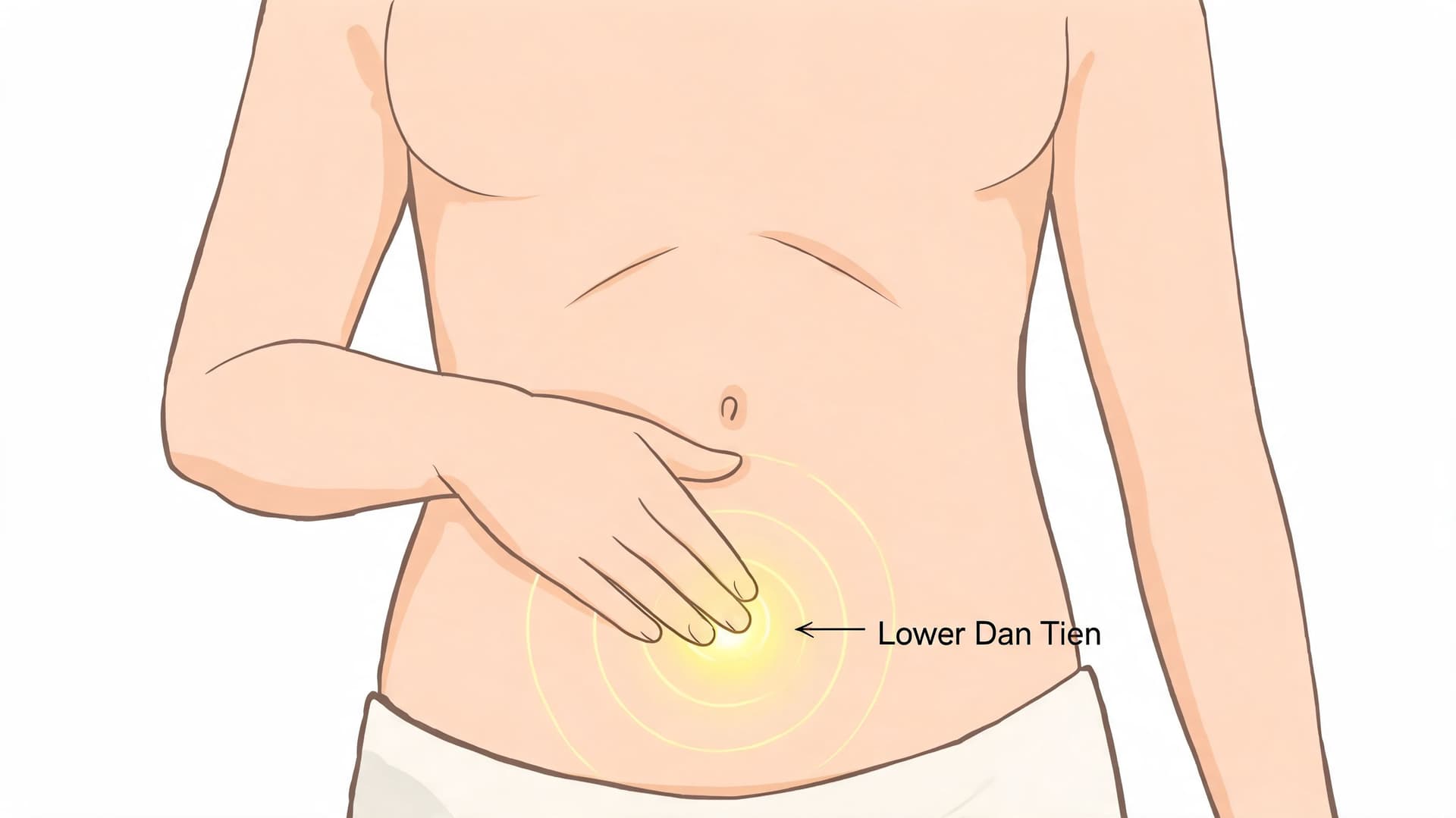
The lower dan tien is often described as “a few inches below the navel,” which can lead to guesswork. This usually creates more confusion than clarity. It helps to think of it as a space in the lower abdomen, not a tiny button you have to find with perfect accuracy.
Start simple. Place one hand below your navel. Then imagine your awareness moving inward toward the center of your pelvis, not just pressing into the skin.

A practical way to find it
A useful beginner method is this:
-
Start below the navel
Rest your fingers a short distance under the belly button. This gives you the general surface area. -
Feel inward, not downward
The lower dan tien is usually taught as being inside the body, not on the surface. Think of a small bowl or sphere deep in the lower belly. -
Relax before you search
If your abdomen is braced, you probably won’t feel much. Soften the belly, jaw, and hips first.
Some people feel warmth there right away. Others feel heaviness, fullness, or almost nothing at first. That’s normal. Subtle awareness usually comes before strong sensation.
Why it’s more than a point
Traditional descriptions are surprisingly specific. The lower dan tien functions as the primary storage and processing center for primordial essence and Yuan qi in traditional Chinese medicine and qigong practice. Its anatomical boundaries are described through three points forming a downward-facing pyramid: the Huiyin point at the perineum, the Shenque point at the navel, and the Mingmen point at the lower back, creating a triangular energy field in the lower abdomen. This configuration is associated with grounding, physical stability, and gravitational centering, as described in the Dantian overview on Wikipedia.
That description helps because it moves us away from a flat, one-point idea. The lower dan tien has depth. It relates to the belly, pelvic floor, and lower back together.
If you’re new to the broader language of qi, this guide on what chi is in simple terms can help make the vocabulary less intimidating.
Practice cue: Don’t poke at the area looking for proof. Rest your hands there and wait for the body to answer in its own language.
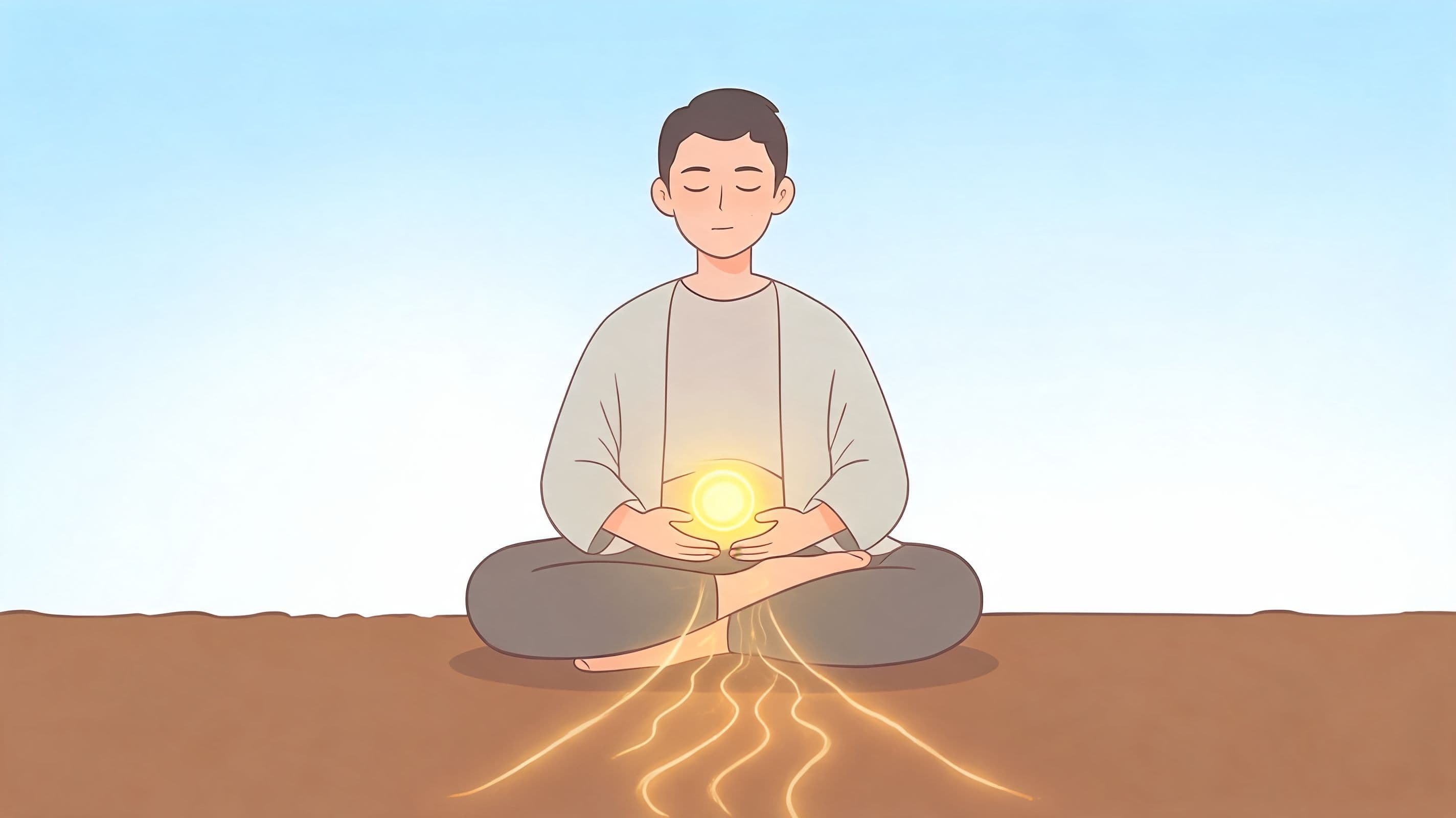
A good image is a glowing sphere inside the lower abdomen. Not because you must visualize light, but because it reminds you that this is a volume of space. Over time, that space may feel warm, dense, quiet, or gently alive. Those are often the first signs that the mind is finally listening to the body.
The Functions of a Healthy Dan Tien
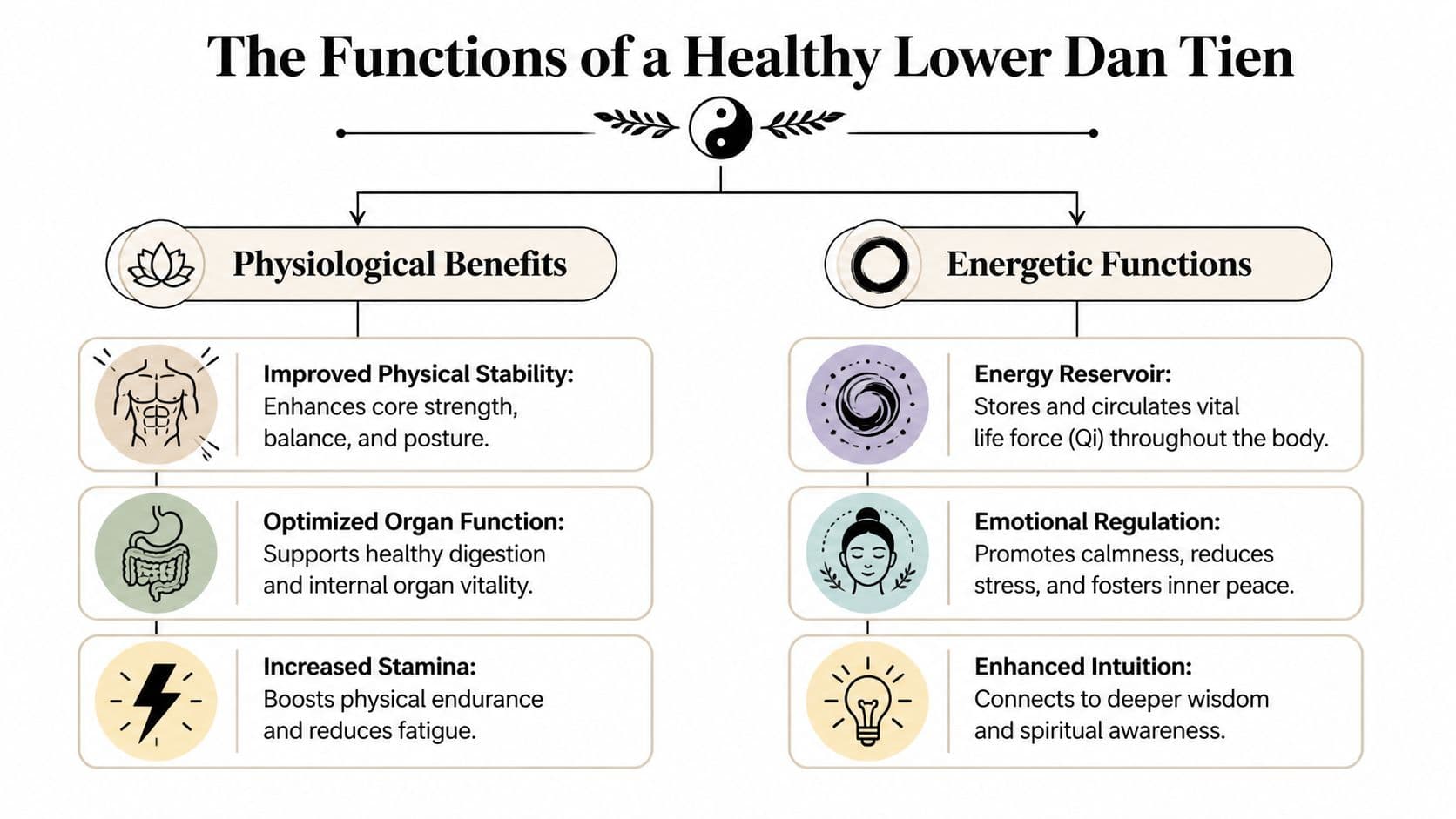
When the lower dan tien is working well, you don’t just “have more energy.” The effects show up in clearer, more ordinary ways. You stand more steadily. Your movements waste less effort. Your breathing supports you instead of fighting you.
I often use the analogy of a rechargeable battery. If the battery is low, every demand feels bigger than it should. If it’s charged, your system has reserve. You’re not scrambling for power every time life asks something of you.

What changes physically
A healthy lower dan tien supports the body in practical ways:
- Balance improves because your sense of center shifts lower
- Core support becomes more natural instead of tight and forced
- Posture steadies because the pelvis, abdomen, and lower back begin working together
- Digestive comfort may improve when the abdominal area is relaxed and coordinated
This is one reason internal arts place so much emphasis on standing postures and slow movement. They train you to organize the body around a stable center rather than muscling through with the shoulders and neck.
What changes energetically
Energetically, the lower dan tien is often described as your main storage area for cultivated qi. I tell students to visualize it as an energy bank account.
If you’re always spending and never storing, you feel thin, reactive, and easily drained. If you regularly gather and settle energy, your system has somewhere to draw from. That reserve often shows up as emotional steadiness, patience, and a stronger sense of internal containment.
A strong dan tien doesn’t make you intense. It makes you less easily pushed around by your own internal weather.
There’s also a traditional link between lower dan tien practice, digestion, and the body’s protective field. According to Energy Arts, when practitioners rotate the dantian in the coronal plane with the left side up and right side down, the motion aligns with the ascending, transverse, and descending colon, promoting enhanced peristaltic function. The same source describes the lower dan tien as the foundational anchor for Wei Qi, or protective energy, and says that as qi accumulates there, the Wei Qi field thickens and extends.
A simple comparison
| Focus | When the lower dan tien is weak | When the lower dan tien is healthy |
|---|---|---|
| Posture | Upper body dominates | Weight settles more evenly |
| Energy | Easily depleted | Better reserve and recovery |
| Emotion | Reactive and scattered | More contained and stable |
| Movement | Effortful and disconnected | Coordinated and rooted |
The useful thing about this framework is that it keeps the topic honest. You don’t need dramatic mystical experiences to know whether practice is helping. If your stance is steadier, breath is deeper, and stress doesn’t knock you over as easily, the work is doing its job.
Symptoms of an Imbalanced Dan Tien
You can often recognize an imbalanced lower dan tien before you know the term for it. The signs show up in familiar patterns. A person feels wired but tired, mentally busy but physically dull, or emotionally touchy without knowing why.
I’ve seen this in students who are bright, capable, and sincere. Their attention lives in the head, their shoulders do too much work, and their lower body feels absent until they deliberately bring awareness back to it.
Common signs in the body
A weak or underused lower dan tien can look like this:
- Poor balance or shakiness when standing still
- Lower back tension from trying to stabilize with the wrong muscles
- Chronic fatigue that feels more like depletion than simple sleepiness
- Shallow breathing that never seems to settle the nervous system
These signs don’t prove one single cause. Bodies are more complex than that. But together, they often point to a lack of grounding and poor integration through the abdomen, pelvis, and breath.
Common signs in the mind and emotions
The emotional side is just as important:
- Overthinking that loops without resolution
- Anxiety or restlessness that makes stillness uncomfortable
- Feeling spacey or not fully present in your body
- Emotional spillover where small events create outsized reactions
If that sounds familiar, it can help to look at the body and emotions together rather than as separate problems. Traditional systems often do that naturally. If you’re curious about those links, this organ emotion chart offers a helpful starting point.
Many people don’t need more motivation. They need more center.
Relationship patterns can reflect the same imbalance. When you’re not grounded in yourself, it’s harder to listen, stay steady during conflict, or feel safe enough to remain open. One verified data point speaks directly to this. A 2025 Taoist study of 450 couples found that daily lower dantian breathing correlated with 18% higher partnership satisfaction scores, as cited in this reference document.
That doesn’t mean breathwork magically fixes relationships. It suggests something more modest and more useful. A steadier body can support steadier connection.
Physical factors matter too. If hormonal swings are part of what’s making you feel uncentered, it may help to discover hormone balancing vitamins alongside your movement and breath practices. That kind of support works best when it’s part of a broader picture, not a substitute for listening to your body.
Many readers who care about life-path work also notice this overlap. Insight without embodiment can stay theoretical. You may understand your patterns clearly and still struggle to live differently because your system doesn’t feel resourced enough to carry that change.
Basic Practices to Cultivate Your Dan Tien
You finish a long day with a busy head, tight shoulders, and the strange feeling that your energy is scattered in ten directions at once. Lower dan tien practice gives that energy one place to gather.
The methods are simple because the goal is simple. You are teaching the body to recognize its center again, the way a battery needs a proper charge point or a tree needs healthy roots.

Practice one. Hands and attention
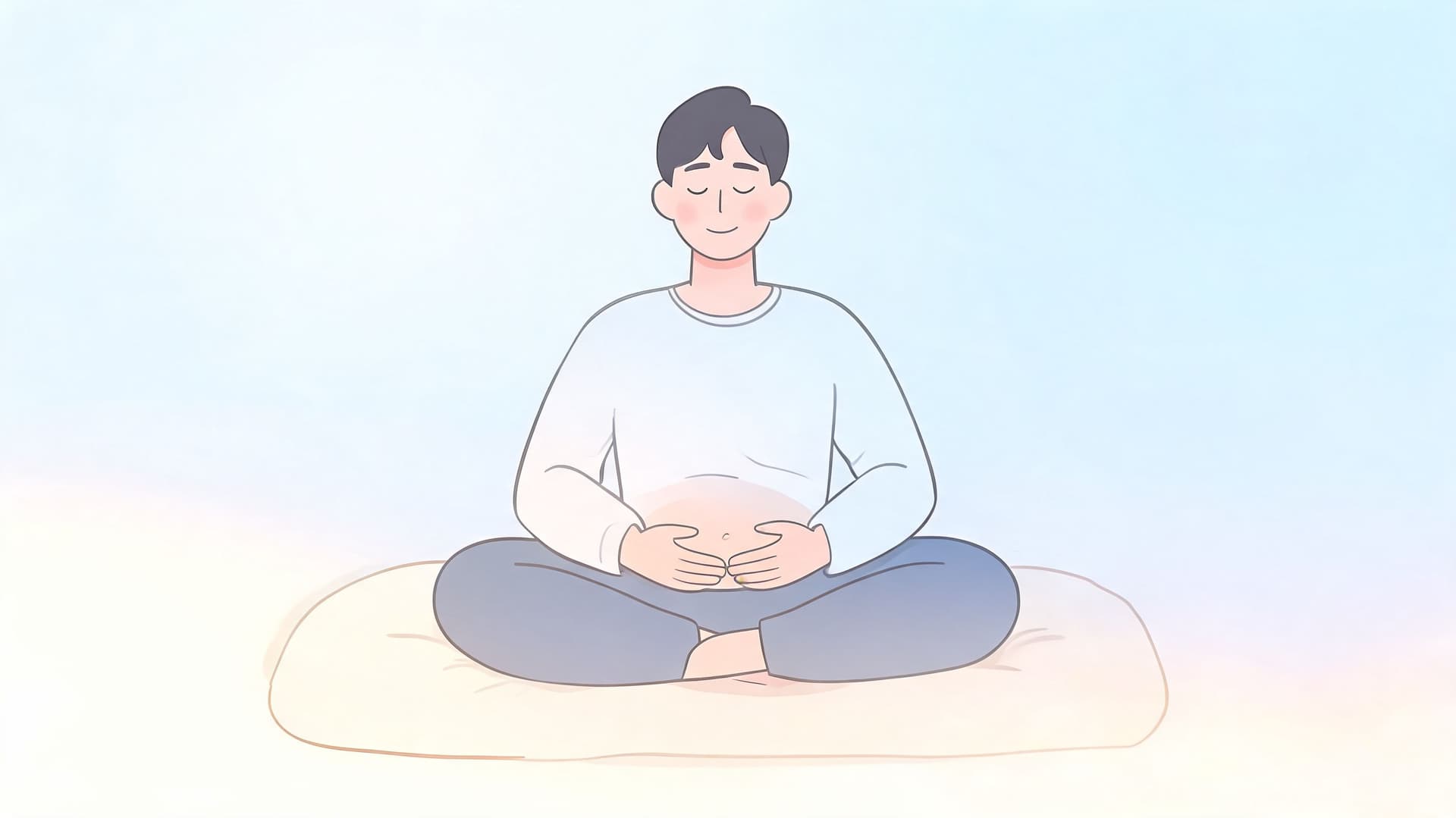
Sit on a chair or stand with your feet planted. Place both hands over the lower abdomen and stay there for one quiet minute.
Feel the contact first. Then notice what is happening underneath your hands. Is the area warm or cool? Does the breath reach the belly easily, or does it stop higher in the chest? Does this part of you feel settled, numb, guarded, or vague?
Many beginners get confused here because they expect a dramatic wave of energy. Usually, the first sign is much plainer. You notice movement. You notice softness. You notice that attention itself begins to wake the area up.
Practice two. Lower belly breathing
This is often considered the clearest starting practice.
- Sit or stand with the spine upright but unforced
- Let the inhale widen the lower belly gently
- Let the exhale release without pushing
- Keep the chest relatively quiet
- Continue for three to five minutes
A good breath here feels calm and round. The belly receives the inhale. The face, jaw, and throat stay easy. If the abdomen is the body's energetic battery, this is one of the most direct ways to charge it.
Research on slow diaphragmatic breathing gives a useful modern reference point. A 2017 review in Frontiers in Psychology found that this kind of breathing can influence stress regulation, attention, and emotional balance through the autonomic nervous system. You do not need to memorize the physiology. What matters in practice is the felt result. More steadiness, less strain, and a clearer sense of being in your body.
Small rule: If your breathing creates tension, reduce the effort.
Practice three. Standing like a rooted tree
Standing practice often helps people feel the lower dan tien faster because gravity gives immediate feedback.
Set yourself up like this:
- Feet a little wider than hip width
- Knees softly bent
- Tailbone relaxing downward
- Chest loose
- Hands resting near the lower belly or hanging at the sides
Then wait.
Feel your weight move into the feet. Let the legs carry you. After a minute or two, the lower belly may begin to feel warm, full, or subtly dense. Those are common signs that your center is becoming more available. A root system works the same way. When the base settles, the whole structure above it needs less effort.
A supportive environment can help you stay consistent. If cushions, mats, or simple meditation accessories would make practice easier, Comfort Pure's meditation offerings are worth browsing.
If you want to add gentle movement to these still practices, this guide to chi gong exercises for beginners pairs well with the breathing work above.
What to avoid
A few habits make lower dan tien practice harder than it needs to be:
- Pushing the belly outward instead of letting it expand on its own
- Tightening the throat or jaw while trying to breathe fully
- Chasing unusual sensations instead of building familiarity
- Practicing too long and turning a settling exercise into a struggle
Consistency matters more than intensity. Five steady minutes each day will do more for your center than one ambitious session every few weeks.
This is also where the link to life-path work becomes practical. Dan Millman gave many readers a language for their lessons and patterns. The Life Purpose App offers a modern version of that same search for direction. Lower dan tien practice helps your body hold what your mind is learning, so insight has somewhere solid to land.
The Dan Tien and Your Life Purpose
There’s a real difference between knowing your path and having the energy to walk it. Many people gain powerful insight into their patterns, gifts, and recurring lessons, then wonder why daily life still feels unstable. The answer is often simpler than it seems. Insight needs a body that can hold it.
That’s where lower dan tien work becomes highly relevant. It gives structure to your inner life. If purpose is a map, the dan tien is part of the vehicle.

The map and the fuel
Dan Millman’s book The Life You Were Born to Live gives people language for the patterns of their life path. That kind of framework can be illuminating. It can help someone recognize where they tend to overreach, withdraw, caretake, control, or avoid.
But recognition alone doesn’t always change behavior. A person may know exactly what they’re here to learn and still feel too scattered, reactive, or depleted to live it cleanly.
That’s why the pairing matters. The verified framing here is strong: somatic work like dan tien cultivation provides the how, while structured life-path insight provides the what. One names the direction. The other helps you build the steadiness to move in that direction.
Why embodiment matters for purpose
Purpose isn’t just an idea you think about. It shows up in the body when you face pressure, disappointment, attraction, fear, and responsibility.
A grounded lower dan tien can support that process by helping you:
- Stay present under stress
- Respond more slowly and clearly
- Recover energy more effectively
- Act from center instead of impulse
You don’t live your purpose with your thoughts alone. You live it with your nerves, breath, posture, and daily choices.
This is one of the overlooked bridges between spiritual study and practice. People often collect insight but neglect capacity. Then they blame themselves for not following through. Sometimes the missing piece isn’t more analysis. It’s more grounding.
If you care about life-path work through Dan Millman’s The Life You Were Born to Live, this perspective can be useful. The body doesn’t replace self-knowledge. It makes self-knowledge usable.
Your Journey to a More Grounded Life
The lower dan tien matters because it gives you somewhere to return when life pulls you upward and outward. It offers a center of gravity for the body, a place to store attention, and a calmer base for action. That sounds simple, but it changes a lot.
You don’t need to master anything this week. Start by placing your hands on the lower belly and breathing there for a few quiet minutes each day. Let your practice be ordinary. Ordinary practice is what builds real depth.
If you’re dealing with physical discomfort while learning to settle into this area, especially around the lumbar spine, it may help to review SunnyBay solutions for back pain. Comfort in the lower back can make grounding work much easier.
For deeper study, find a qualified teacher in Qigong, Tai Chi, or a body-based meditative discipline who emphasizes safety, structure, and lived experience over performance. A good teacher won’t pressure you into exotic sensations. They’ll help you notice what’s already happening and refine it.
The lower dan tien isn’t far away. It’s in the part of you that’s been waiting for your attention to come home.
If you want to explore how grounded embodiment can support deeper self-knowledge, the Life Purpose App is a practical companion to Dan Millman’s The Life You Were Born to Live. It helps you explore life-path insight in a structured way, and that can pair beautifully with the steady, body-based work of lower dan tien practice.
Discover Your Life Purpose Today!
Unlock your true potential and find your life’s purpose.