Discover how to use mudras for power. This practical guide provides step-by-step instructions for hand gestures that boost confidence, energy, and clarity.
April 24, 2026 (4mo ago) — last updated July 7, 2026 (1mo ago)
Mudras for Power: A Guide to Unlock Your Inner Strength
Discover how to use mudras for power. This practical guide provides step-by-step instructions for hand gestures that boost confidence, energy, and clarity.
← Back to blog
Some days the loss of power is obvious. You wake up tired, scroll before your feet hit the floor, rush into work, and by noon you can feel your attention leaking out in six directions at once. Other days it’s quieter. You answer everyone else’s needs, keep functioning, and still feel strangely disconnected from your own center.
That’s the moment when mudras for power become useful.
Not as a magic trick. Not as spiritual decoration. As a practical method for changing your state with the tools you already carry on your body. Your hands can help you gather your attention, steady your breath, and direct energy more intentionally when your mind feels scattered or your confidence drops.
I teach mudras the same way I teach meditation. Keep it simple enough to use on a hard Tuesday, not just on a retreat. If a practice only works in perfect silence with a candle lit at sunset, it's unlikely to be sustained. Mudras work best when they can meet real life.
Tapping Into Your Innate Power
Power, in yoga, isn’t aggression or control. It’s the ability to stay connected to yourself while life pulls on you. It’s steadiness under pressure, clear decision-making, and enough vitality to act on what matters.
Mudras support that kind of power by shaping the flow of prana, often described as life force energy. If that language feels abstract, think of it this way. Your body and mind respond to posture, breath, attention, and touch. Mudras combine all four in one small gesture.
According to Azulfit’s overview of hand mudras, mudras form a system of approximately 399 to 400 distinct forms, and these gestures have been part of ritual and contemplative practice for thousands of years. The same source explains the elemental map often used in yoga: thumb as fire, index finger as air, middle finger as ether or space, ring finger as earth, and pinky as water.
How the hand becomes an energy circuit
When you place specific fingers together, you’re completing a subtle circuit. In traditional yoga theory, that circuit redirects energy through the body’s pathways. In practice, most students notice three things first:
- Mental quieting when the hands stop fidgeting and the breath slows
- Emotional steadiness when attention has a physical anchor
- A clearer felt sense of confidence, grounding, or vitality depending on the mudra
Mudras are small gestures with a big job. They turn vague intention into something your body can actually practice.
If you want a plain-language bridge into this idea of life force, the Life Purpose App offers a helpful explanation of chi. Chi and prana come from different traditions, but both point toward the same lived reality. Energy rises, drops, gets blocked, and can be trained.
Why intention matters
A mudra without attention is just finger placement. A mudra with breath and intention becomes practice.
That’s why I often pair mudras with a simple sentence or inner direction. If you’re working on self-trust, that intention needs to be clear and believable. This guide on effectively using affirmations is useful because it shows how to work with language in a way that feels grounded instead of forced.
Your hands don’t create power from nowhere. They help you access the power you’ve stopped feeling.
The Foundation of a Powerful Mudra Practice
A lot of people try mudras once, feel nothing dramatic, and assume they don’t work. Usually the problem isn’t the mudra. It’s the setup.
When you build a strong base, even a simple hand gesture becomes more effective. For power work, I pay attention to posture, breath, and the quality of touch.
Sit in a way that lets energy move
You don’t need a perfect lotus pose. You do need a position that doesn’t compress your breath or collapse your chest.
Try this:
- Lengthen the spine by sitting on a cushion, chair, or folded blanket.
- Relax the shoulders so the neck stays soft.
- Rest the hands comfortably on the thighs or in the lap.
- Keep the jaw loose and the face neutral.
If you’re practicing in a chair at work, place both feet on the floor and sit slightly forward instead of sinking into the backrest. That one change often sharpens the whole practice.
Breathe with the mudra, not around it
For power-focused mudras, I prefer to bring in ujjayi breathing. It gives the mind a rhythm and makes the gesture feel less passive. The sound is subtle, like a soft whisper in the throat, never harsh.
The specific protocol given in this power-focused mudra guidance is clear: practice three daily sessions of 10 minutes each, combine the mudra with 12 to 15 breaths of ujjayi while holding the gesture, and use light contact rather than pressing hard.
That last part matters more than most beginners expect.
Practical rule: If your fingers are straining, you’re doing too much. Mudras respond better to sensitivity than force.
The most common mistake
People often try to make a mudra “work” by squeezing the fingers together. That creates tension in the hands, forearms, shoulders, and even the breath. Tension narrows awareness. It doesn’t deepen it.
Use just enough contact to complete the gesture. The fingertips meet. They don’t wrestle.
Here’s a quick reference I give students:
| Part of practice | What helps | What gets in the way |
|---|---|---|
| Posture | Upright, relaxed spine | Slumping or rigid posing |
| Breath | Slow ujjayi, steady rhythm | Holding the breath or forcing it |
| Touch | Light finger contact | Excessive pressure |
| Attention | Clear intention | Multitasking mentally |
If you already work with chakras, the Life Purpose App blog offers a useful companion read. It can help you understand why certain mudras are often paired with specific energetic centers, especially the solar plexus when the focus is personal power.
Mindset changes the result
The best mudra practice isn’t dramatic. It’s consistent, attentive, and honest.
Before you begin, decide what kind of power you’re cultivating. It might be courage for a hard conversation. It might be stamina at the end of a long day. It might be the steadiness to stop reacting and start choosing.
That gives the gesture direction. Without that inner direction, the mudra can still calm you, but it won’t feel as precise.
Three Essential Mudras to Cultivate Your Power
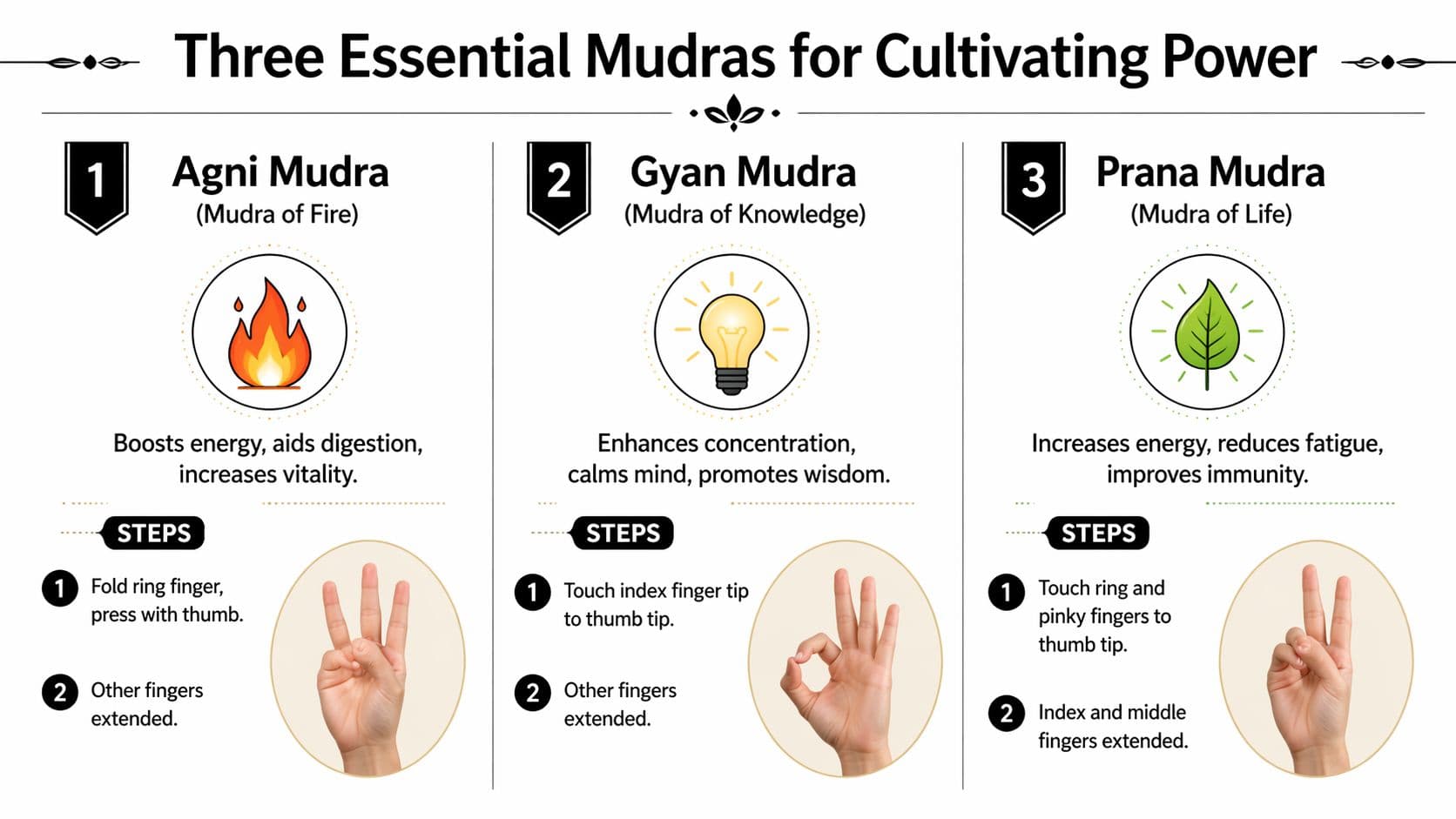
When people ask me where to start, I don’t give them a list of ten. I give them three that cover different kinds of power. One builds authority, one restores vitality, and one stabilizes the mind.
Rudra Mudra for inner authority
Rudra Mudra is one of my favorite practices for moments when someone feels capable on paper but disconnected from their own conviction. It’s traditionally linked with strength, reshaping force, and the solar plexus center.
To make the mudra, bring the thumb, index fingertip, and ring fingertip together. Let the middle finger and pinky stay relaxed and extended without stiffness. Rest the hands on the thighs, palms facing up if that feels natural.
The effect is different from a calming mudra. Rudra has more presence to it. It tends to gather your energy inward, then direct it forward.
Use it when:
- You need backbone before a conversation where you usually shrink
- You’re overthinking and need to return to decisive action
- Your digestion and stress feel linked, which is common when personal power is low
I like this mudra before teaching, speaking, interviewing, or setting a boundary. It’s not flashy. It’s centering.
Hold Rudra Mudra when you need to stop asking for permission from the room.
A practical approach is to sit with it and breathe naturally or use the ujjayi pattern described earlier. Let your attention settle in the upper abdomen. Don’t try to manufacture confidence. Just practice inhabiting yourself more fully.
Prana Mudra for vitality and resilience
If Rudra is about direction, Prana Mudra is about fuel.
This mudra is formed by touching the thumb to both the ring fingertip and pinky fingertip, while the index and middle fingers stay extended. Traditional elemental theory sees this as a meeting of fire, earth, and water. In lived practice, many people experience it as replenishing.
The source I’m drawing from here, The Yogatique’s discussion of Prana Mudra, describes it as a strong support for states of energy depletion. The same source notes that its effect grows when combined with visualization and clear intention-setting, and that consistency is more predictive of outcomes than duration.
That lines up with what I see in students. A person who does Prana Mudra briefly every day usually gets more from it than someone who does one long session and forgets it for a week.
How to practice Prana Mudra
Try this sequence:
- Form the gesture with both hands.
- Soften the shoulders and belly.
- Breathe slowly and imagine energy rising from the base of the body upward.
- Name the intention clearly. “Restore my energy” is enough.
- Stay with it for a short daily practice or use it during a low-energy moment.
This mudra works especially well:
- In the morning before checking your phone
- During the afternoon slump when your focus starts to drop
- Before sleep if exhaustion has become wired and restless rather than peaceful
There’s an important trade-off here. Prana Mudra can support energy, but it doesn’t replace rest, nourishment, or a sane schedule. If someone is sleeping too little and expecting a mudra to erase that, frustration follows. Use the mudra as support, not as denial.
Bhairava Mudra for grounded steadiness
Some forms of power are quiet. Bhairava Mudra develops that kind.
This gesture is done by placing the right hand over the left, palms facing upward, and resting the hands in the lap. It doesn’t ask the nervous system to rev up. It asks it to settle into a more stable center.
I use Bhairava when a student says, “I don’t need more motivation. I need to stop being thrown off by everything.” That’s a different problem, and it needs a different mudra.
Bhairava is useful when:
- You feel mentally noisy
- You’re absorbing other people’s intensity
- Your confidence collapses under pressure because your system is overstimulated
Choosing the right mudra for the moment
If you’re unsure where to begin, this simple comparison helps.
| Mudra | Best for | Felt quality |
|---|---|---|
| Rudra Mudra | Confidence, boundaries, decisive action | Focused, strong, upright |
| Prana Mudra | Fatigue, low motivation, depleted energy | Nourishing, revitalizing, bright |
| Bhairava Mudra | Stress, overstimulation, grounding | Stable, quiet, contained |
How long to hold them
I don’t chase intensity. I chase repeatability.
If you’re new, start with one mudra and stay long enough to notice a change in breath, posture, or mental tone. If you’re experienced, you can hold a mudra longer within a meditation session. What matters most is that the practice becomes part of your life rather than another abandoned ritual.
A useful personal test is simple. After practicing, do you feel more gathered, more present, and more capable of acting well? If yes, the mudra is doing its job.
Weaving Mudras Into Your Daily Routine
The best mudra practice is the one you’ll still be doing when life gets busy.
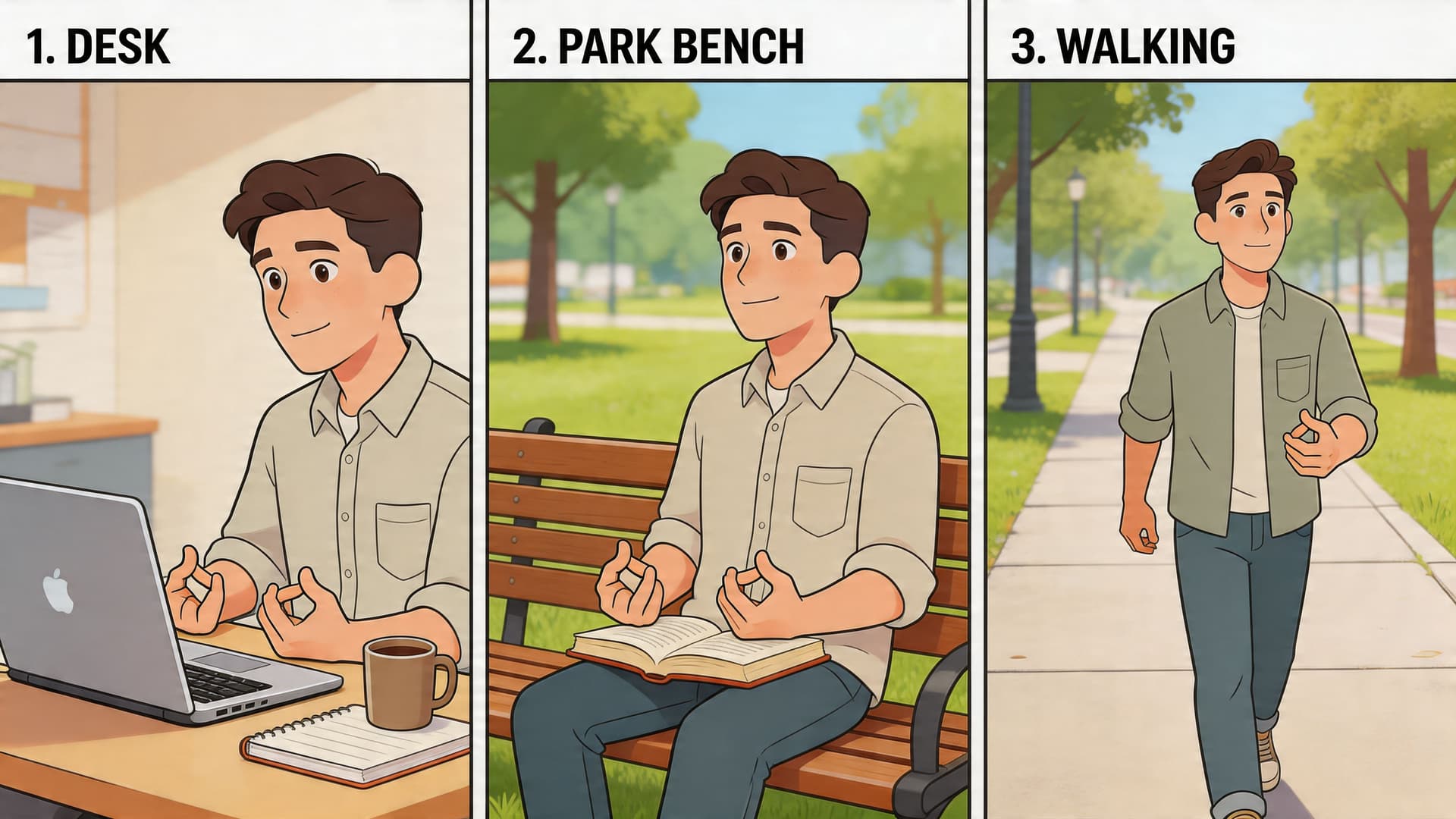
I’ve seen people make mudras too ceremonial, then quietly stop. You don’t need to protect them in a glass case. They travel well. They’re discreet. They fit into ordinary moments without asking for extra time.
What this looks like in real life
A client once started using Rudra Mudra before team meetings. Not in a dramatic way. Just seated, hands low, a few slow breaths before anyone joined the room. She told me the shift wasn’t that she suddenly became louder. She stopped second-guessing herself while speaking.
Another student used Prana Mudra during his commute home because that was the exact point in the day when he usually crashed and reached for stimulation. The mudra gave him a pause between work fatigue and the rest of the evening.
Bhairava Mudra is ideal for the hidden moments. Under a desk before a difficult email. On the sofa when your mind won’t stop replaying a conversation. In bed when you’re tired but can’t settle.
You don’t have to leave your life to practice. Bring the practice into the life you already have.
A simple morning sequence
If you want one dependable ritual, keep it short enough that resistance doesn’t win.
Try this:
- Sit up before you look at your phone
- Choose one mudra based on the day ahead
- Take a few slow breaths
- Add a breathing rhythm if you want more structure
For that last piece, the Life Purpose App has a clear guide to three-part breath. It pairs well with mudras because it expands awareness through the belly, ribs, and chest in a very direct way.
Make the practice easier to keep
A few patterns help people stay consistent:
- Attach it to a cue like morning tea, the train ride, or shutting your laptop
- Use one mudra for one purpose so your body starts linking the gesture with a state
- Stay realistic and practice briefly rather than waiting for the perfect long session
What doesn’t work is treating mudras like emergency theater. If you ignore your state all week and then demand instant transformation in the middle of a crisis, the practice won’t feel trustworthy. Repetition builds familiarity. Familiarity builds access.
Personalize Your Practice with Your Life Path
General advice helps. Personal insight helps more.
Most articles about mudras for power stop at a list. Use this mudra for confidence. Use that one for vitality. That’s useful, but it misses something important. People don’t all struggle with power in the same way.
Some people need courage to lead. Some need grounding so their gifts don’t scatter. Some need restraint, because their force is strong but poorly directed.
Why life path insight changes the practice
Dan Millman’s The Life You Were Born to Live provides a richer lens. In that system, your birth date points toward a life path with core gifts, challenges, and lessons. When you understand those patterns, your mudra practice becomes more targeted.
That personalized angle is still largely missing in wellness content. As noted in this discussion of the content gap around mudras and personal numerology, top search results generally don’t address tailoring mudras to birth-date-derived profiles, even though that pairing offers a meaningful way to work more precisely with personal growth.
The point isn’t to turn mudras into another identity label. The point is to choose practices that meet your real pattern.
Matching the mudra to the lesson
Dan Millman’s system includes life paths that often carry themes around leadership, independence, responsibility, sensitivity, or self-mastery. If you know your path through The Life You Were Born to Live and check it in the Life Purpose App, you can start asking better questions.
For example:
- Leadership-oriented themes often benefit from Rudra Mudra, especially when the challenge is hesitation, self-doubt, or diffused will
- Highly sensitive or emotionally porous themes may respond better to Bhairava Mudra, because grounded containment is more useful than extra stimulation
- Paths that struggle with depletion or inconsistency often pair well with Prana Mudra, since the issue isn’t lack of vision but difficulty sustaining energy
The right mudra doesn’t flatter your self-image. It trains the quality you actually need.
A grounded way to use this
Keep the process practical.
| If your life path work points to | Try this mudra | Ask yourself |
|---|---|---|
| Leadership and self-trust | Rudra Mudra | Where do I give away authority? |
| Sensitivity and overstimulation | Bhairava Mudra | What helps me stay centered in contact with others? |
| Fatigue and inconsistent follow-through | Prana Mudra | What restores my energy without drama? |
This is one of the reasons I like combining ancient practices with a clear self-knowledge framework. A mudra doesn’t need to be chosen randomly. It can become part of a disciplined inner conversation.
If you work with Dan Millman’s material, keep the spirit of the system intact. Use it to become more honest, not more rigid. Your life path can point toward likely lessons, but your daily practice still needs observation. Try the mudra. Notice the result. Adjust from there.
Your Hands Hold the Key to Your Power
Power doesn’t arrive from outside you. Practice helps you remember where it lives.
Mudras make that reminder tangible. Your hands become a direct way to steady the mind, gather energy, and shift from reactivity into presence. You don’t need to master dozens of gestures. Start with one that meets your real need right now.
The encouragement I give beginners is simple. Begin small and stay consistent. According to the Times of India overview of mudra practice, 5-minute sessions can begin subtle energy shifts, while 20 to 45 minutes can bring stronger physiological changes. That’s a useful reminder that small practice counts, and deeper effects often come with time.
Choose one gesture. Practice it daily. Let your body learn it.
When you want more depth, align the practice with the lessons that are already shaping your life. That’s where mudras stop being interesting and start becoming transformational.
If you want to take that personalized approach further, the Life Purpose App can help you explore your life path through Dan Millman’s The Life You Were Born to Live and apply that insight to your spiritual practice in a grounded, practical way.
Discover Your Life Purpose Today!
Unlock your true potential and find your life’s purpose.
