Confused about virtues vs values? Learn the difference, why alignment matters for purpose, and practical steps to harmonize your priorities with timeless virtues.
March 11, 2026 (5mo ago) — last updated July 16, 2026 (1mo ago)
Virtues vs Values: Aligning for a Purposeful Life
Learn the difference between virtues and values, why alignment matters for purpose, and practical steps to harmonize them for a meaningful life.
← Back to blog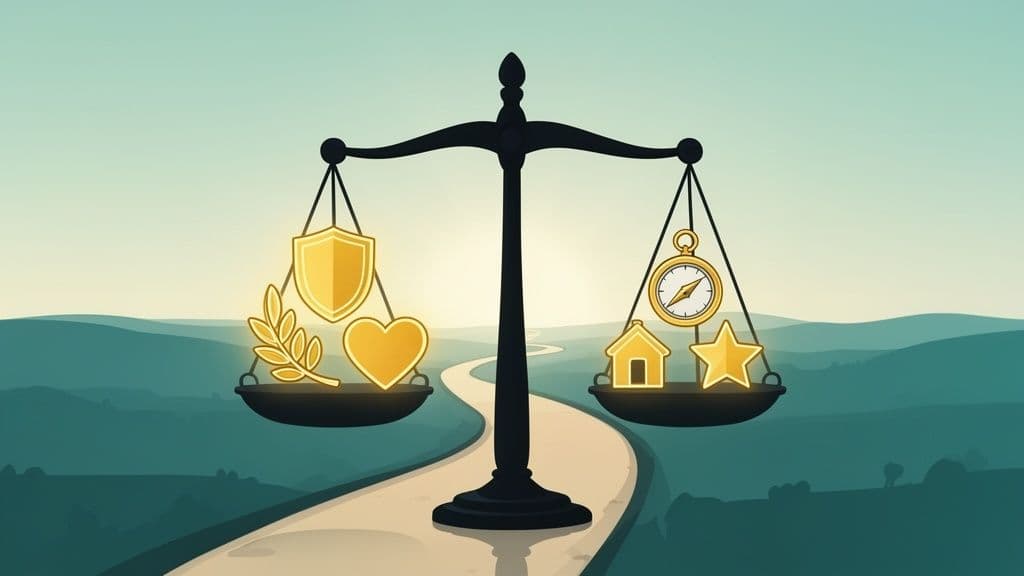
So, what’s the real story when it comes to virtues vs values? It’s easy to use these words as if they mean the same thing, but they come from two different places. Here's the most straightforward way to think about it: virtues describe who you are; values describe what you prioritize.
One reflects your inner character; the other maps your personal choices.
Distinguishing character from choice
Virtues are the bedrock of character. Think of them as timeless principles of moral goodness—honesty, courage, compassion, and justice. These qualities recur across cultures and history as central to a well-lived life.
Values are deeply personal. They are the beliefs, preferences, and priorities you decide are important—family, adventure, financial security, or creativity. Values can and often do shift as experiences and circumstances change.
Put simply: virtues are objective ideals we cultivate; values are subjective priorities we choose.
Virtues vs values: a quick comparison
| Attribute | Virtues | Values |
|---|---|---|
| Origin | Universal moral principles | Personal beliefs and priorities |
| Nature | Enduring and practice-based | Flexible and context-dependent |
| Focus | Character and being (who you are) | Priorities and doing (what you choose) |
| Example | Honesty, Compassion, Courage | Success, Family, Adventure |
Seeing them side-by-side clarifies the difference: virtues provide the “how” and “why” of our moral compass, while values point to the “what” we aim for in daily life.
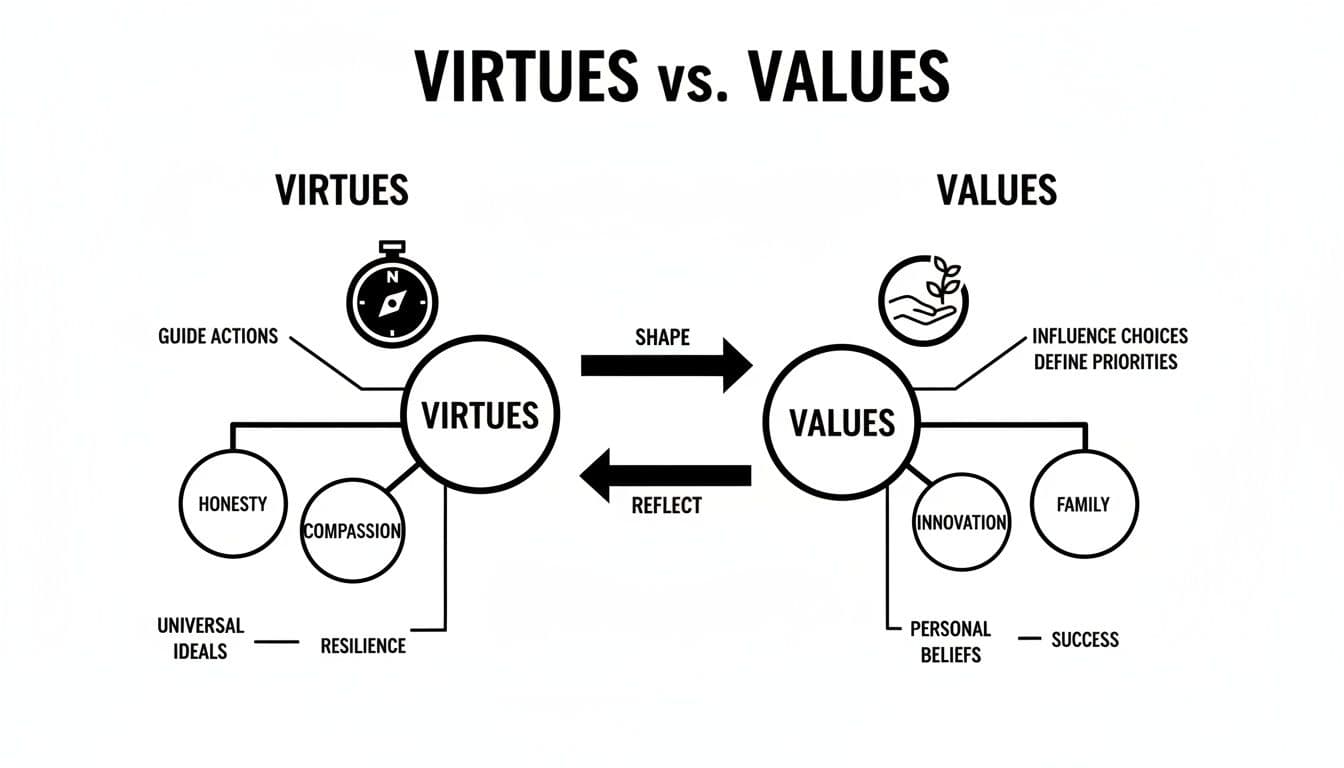
Your values are the choices you make; the most fulfilling life comes when those choices are guided by timeless virtues.
You don’t get to choose your virtues—they are standards of goodness. You do choose your values, and the wisest choice is to align them with virtue.
Understanding this relationship is more than a philosophical exercise; it is a practical tool for self-discovery. This idea is central to frameworks like Dan Millman’s book, “The Life You Were Born to Live.” The Life Purpose App helps translate the concept into practice by showing how spiritual laws and innate qualities shape your path5.
Uncovering the ancient roots of virtue
The concept of virtue is ancient and practical. Thinkers such as Aristotle created blueprints for building strong character; for them, virtues were habits that forge a good life4.
These ideas are not just Western. Across global wisdom traditions, the same core principles reappear. They act as a universal moral compass, steady regardless of what’s in vogue.
Six core virtues of humanity
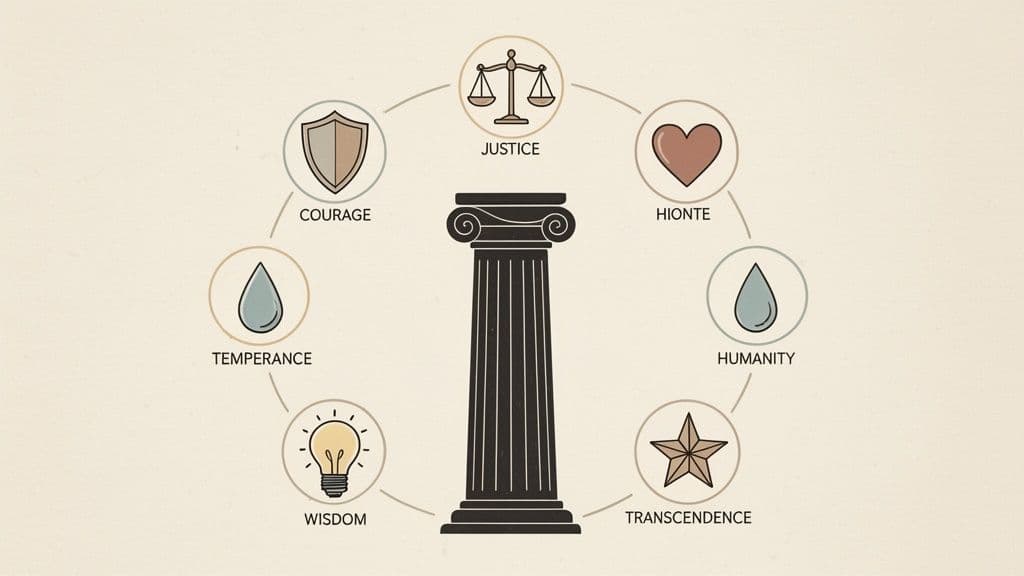
Philosophical and spiritual texts often return to six core virtues essential for flourishing: wisdom, courage, humanity, justice, temperance, and transcendence. These pillars form the bedrock of a well-lived life:
- Wisdom and knowledge: the drive to learn, understand, and apply insight.
- Courage: the fortitude to act despite fear or difficulty.
- Humanity: compassion, kindness, and connection with others.
- Justice: a commitment to fairness and the common good.
- Temperance: balance, moderation, and self-control.
- Transcendence: connection with meaning larger than the self.
Virtues are active qualities. Aristotle’s idea of the “golden mean” shows virtue as the midpoint between extremes—courage is not fearlessness but balance between recklessness and cowardice4.
Virtue as a cultivated habit
You don’t simply choose a virtue the way you choose a value; you practice it. Virtue is a skill honed by daily effort—like building muscle or learning an instrument. Repetition turns an idea into an integral part of who you are.
Many spiritual frameworks echo this practice-based view of ethics. For example, the ethical limbs of yoga, the Yamas and Niyamas, show how tangible actions and restraints cultivate virtue.
Virtue is not a fleeting feeling or preference; it is the enduring quality of character, forged through deliberate action and consistent practice.
Modern self-discovery tools often build on this wisdom. Dan Millman’s work and the Life Purpose App offer systems for seeing how ancient virtues play out in your life and how to cultivate your strengths intentionally5.
How personal values shape your life blueprint
If virtues are the North Star, values are the hand-drawn map you create for your life’s journey. Values guide daily decisions and shape choices about career, relationships, and priorities.
Unlike virtues, values are dynamic. They evolve as you gain experience and clarify what truly matters to you.
Values as your personal GPS
Values act as a personal GPS, dictating the turns you take and the destinations you aim for. Someone who values adventure may leave a steady job to travel; someone who values security may build a life focused on stability.
Neither path is inherently right or wrong—they are expressions of different value systems. Values steer:
- Your career: a value of service may lead to healthcare; a value of innovation may lead to tech.
- Your relationships: valuing deep connection leads to different social choices than valuing a broad network.
- Daily choices: purchases and habits reflect what you prioritize.
Discovering professional values is a critical part of the map, and it connects to your broader life design.
The risk of values without virtue
“Living your values” is powerful, but values pursued without virtues can cause harm. If what you want conflicts with what is right, you can end up with a shaky moral code.
For example, valuing success “at all costs” may clash with the virtue of honesty, creating internal conflict and harm to others.
A life built only on personal values is like a ship with a detailed map but no compass. You might know where you want to go, but without the steady pull of virtue, you can get lost in a storm.
Aligning values with virtues starts with radical honesty about what matters. Our guide on how to discover your core values can help begin that exploration.
When virtues and values clash in life and society
The friction between virtues and values shapes individuals and societies. Historically, shared virtues such as duty and civic responsibility helped hold communities together. When a culture shifts toward celebrating individual values over shared virtues, social cohesion can weaken.
Researchers and commentators have documented shifts in social norms and crime patterns during cultural transitions. Observers have traced changes from Victorian-era norms to modern individualism and discussed associated social outcomes1.
A look at the societal impact
Some historical analyses suggest links between collective commitments to virtue and social health. For example, historians and social commentators have pointed to changes in social behavior across the 19th and 20th centuries and discussed their causes and effects1.
The inner conflict of virtues vs values
This clash also happens within us. You may value financial security and work long hours, but if a shortcut to promotion requires bending the truth, the virtue of honesty conflicts with your value.
That internal friction signals that your moral blueprint needs reassessment. A life of integrity is not just achieving valued outcomes but becoming a person of virtue.
Dan Millman’s approach often highlights how individual life challenges and strengths relate to this tension; the Life Purpose App can help you identify where your values and virtues intersect and where growth is needed5.
Aligning values with virtues for a purpose-driven life
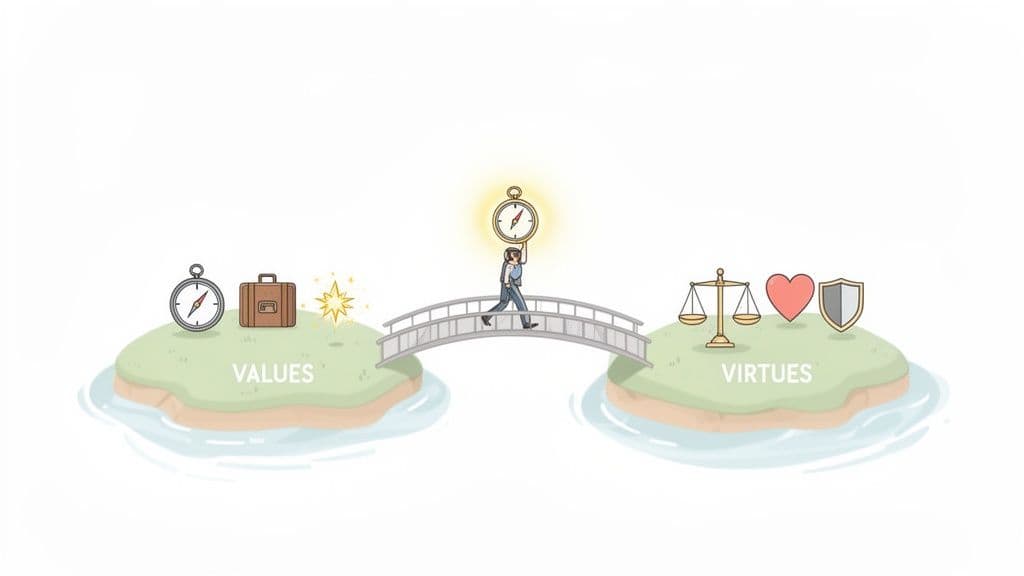
The real transformation occurs when your chosen values align with the virtues you are cultivating. When personal priorities harmonize with timeless moral principles, you build a purpose-driven life.
This is practical work: clarify your core values, then measure them against virtues such as integrity, compassion, and courage.
From personal preference to principled living
Take the common value of “success.” On its own, success is neutral. The meaningful difference is how you pursue it:
- Does your definition of success require integrity, or do you cut corners?
- Does it align with humanity and justice, or do you view success as zero-sum?
Refine values through journaling and reflection. Asking, “How can my value of adventure serve the virtue of courage?” reframes goals from self-focused to purpose-driven. Brief, consistent reflection improves self-regulation and goal alignment3.
Both Dan Millman’s book and the Life Purpose App offer systems to connect personal paths to broader spiritual laws and virtues, helping you move from intention to practice5.
Universal virtues in a diverse world
While values vary by culture, research into human values and moral priorities finds strong commonalities across nations. Large cross-national surveys show similar patterns in how people rank core virtues, suggesting underlying universals in moral outlooks2.
Living a life of purpose means filtering personal values through universal virtues, so what you want is guided by what is right.
In professional and care settings, applying virtue-informed frameworks—such as trauma-informed principles—shows how action guided by ethical virtues leads to better outcomes.
The goal is a life where actions driven by values consistently reflect the person you intend to become.
Common questions answered
| Question | Answer |
|---|---|
| Can my values be bad? | Values are neutral; outcomes matter. Valuing wealth is not inherently bad, but if it leads to dishonesty, it conflicts with the virtue of honesty. Choose values that support justice, compassion, and integrity. |
| What if my virtues and values conflict? | Don’t panic. That tension signals attention is needed. Acknowledge the conflict, then decide whether you will prioritize short-term wants or long-term character. Growth often begins where values and virtues collide. |
| Is it better to be virtue-focused or value-focused? | See virtues as the foundation and values as your expression. Start with non-negotiable virtues, then select values that let you express those virtues uniquely in your life. |
Working through these questions is practical—the work of building a meaningful life, one conscious choice at a time.
Ready to decode your unique life path and understand the core spiritual laws shaping your journey? Discover your purpose with the Life Purpose App, the official digital companion to Dan Millman’s work. Get started for free at https://lifepurposeapp.com.
Quick Q&A — concise guidance
Q: How do I tell if a value conflicts with a virtue?
A: Test outcomes. If pursuing a value harms others or forces you to compromise honesty or compassion, it conflicts with virtue. Reframe the value to serve a virtuous aim.
Q: What daily practice helps align values and virtues?
A: End-of-day reflection: note one action that reflected virtue, one that did not, and one small adjustment for tomorrow. This builds habit and accountability3.
Q: Where do I start if my life feels misaligned?
A: List your top three values and hold each against core virtues like integrity and compassion. Choose one small, concrete step that brings a value into alignment with a virtue.
1.
American Enterprise Institute, “From Victorian Virtues to Modern Values,” event page, [https://www.aei.org/events/from-victorian-virtues-to-modern-values/].
2.
World Values Survey, WVS website and datasets, [https://www.worldvaluessurvey.org/WVSContents.jsp].
3.
American Psychological Association, “Writing to Heal: Benefits of Expressive Writing,” [https://www.apa.org/monitor/2011/01/writing].
4.
Stanford Encyclopedia of Philosophy, “Aristotle: Ethics,” [https://plato.stanford.edu/entries/aristotle-ethics/].
5.
Dan Millman, “The Life You Were Born to Live,” and The Life Purpose App, [https://www.thelifepurposeapp.com/free-report].
Discover Your Life Purpose Today!
Unlock your true potential and find your life’s purpose.
