Feeling stressed or drained? Discover the ancient principle of yin and yang balance. Learn to spot imbalances and use practical tips for a more harmonious life.
April 21, 2026 (5mo ago) — last updated July 24, 2026 (1mo ago)
Yin and Yang Balance: A Guide to Restoring Harmony
Feeling stressed or drained? Discover the ancient principle of yin and yang balance. Learn to spot imbalances and use practical tips for a more harmonious life.
← Back to blog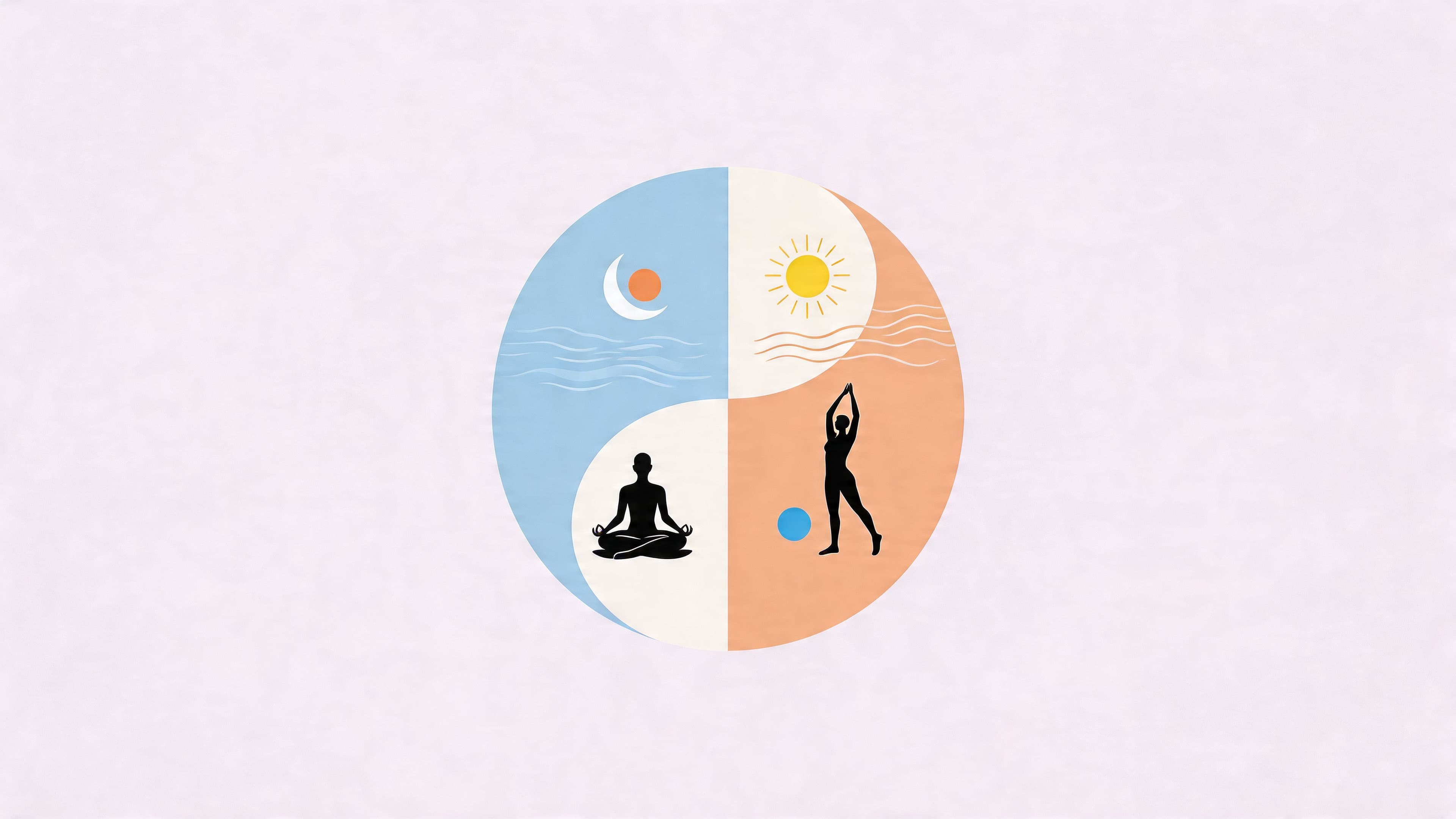
Some days feel strangely split. Your mind is racing, your body is dragging, and you can’t tell whether you need a nap, a walk, or a complete reset. You answer messages, move from task to task, and still feel behind. Then bedtime comes, and instead of softening into sleep, your brain stays bright and busy.
A lot of people call this stress. That’s partly true, but it’s often more useful to look at it as imbalance. Not failure. Not weakness. Just a system that’s leaning too hard in one direction for too long.
The old language of yin and yang balance gives us a clear way to understand this. It helps explain why someone can feel overstimulated and depleted at the same time, why rest doesn’t always feel restorative, and why pushing harder often makes things worse. This framework is ancient, but it speaks directly to modern life because modern life pulls us out of rhythm in very ordinary ways.
That Feeling of Being Both Wired and Tired
You wake up already tense. Coffee helps for a little while, then your focus starts scattering. By afternoon, you feel flat, but if you sit still for too long, you get restless. At night, your body says exhausted, but your mind says keep going.
That split feeling is common in burnout, poor sleep, and chronic overstimulation. If you’ve been trying to make sense of why you wake up tired every morning, sleep quality is only part of the picture. Your inner rhythm matters too.
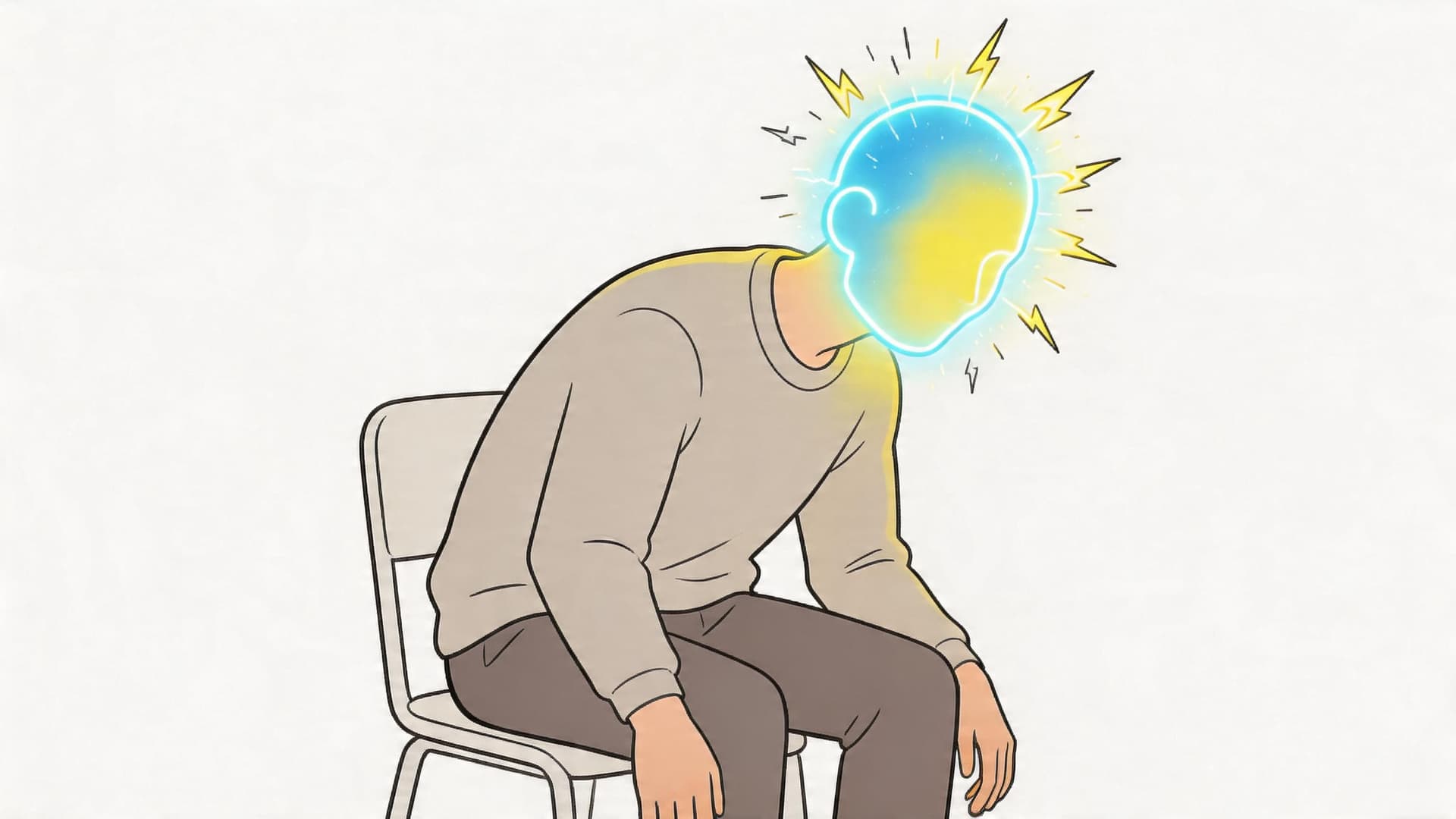
A person in this state often says things like:
- “I’m exhausted, but I can’t switch off.”
- “I’m busy all day, but I don’t feel productive.”
- “I want rest, but real rest feels unreachable.”
That’s where yin and yang become practical instead of abstract. In simple terms, yang relates to activity, output, stimulation, movement, heat, and outward focus. Yin relates to rest, recovery, stillness, cooling, inward attention, and nourishment. Both are necessary. Problems begin when one dominates and the other can’t do its job.
Practical rule: If your life contains constant output but little real recovery, your body will eventually ask for balance in louder ways.
Sometimes that shows up as poor sleep. Sometimes irritability. Sometimes brain fog. Sometimes the heavy, depleted feeling people associate with burnout. If that sounds familiar, this guide offers another useful lens on what happens when your system has been running too hot for too long.
Yin and yang balance doesn’t ask you to become passive or perfect. It asks you to notice what’s missing, then restore what supports wholeness.
The Ancient Dance of Yin and Yang
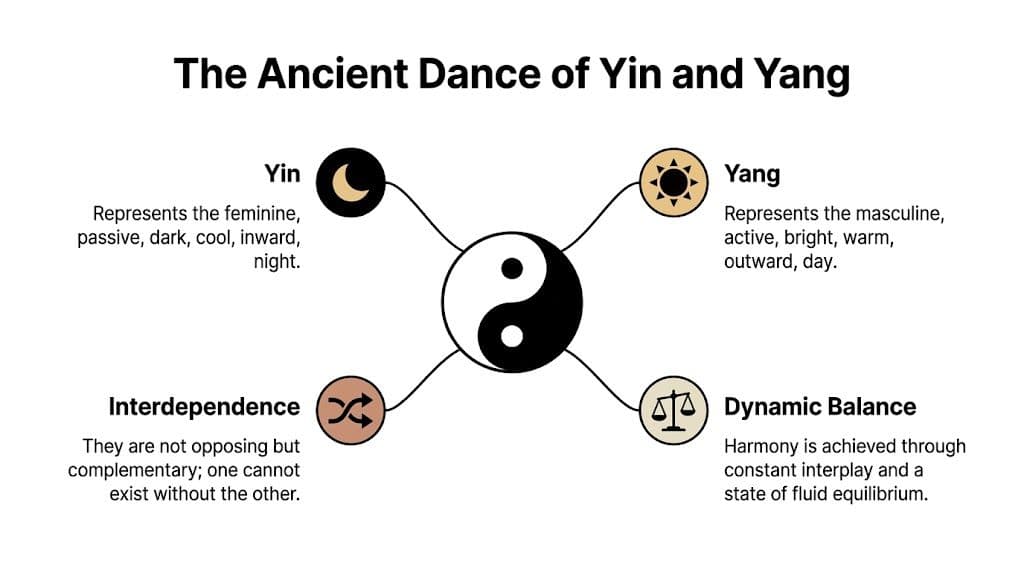
The easiest way to understand yin and yang is to stop thinking of them as enemies. They’re partners. Day needs night. Breathing in depends on breathing out. Summer grows from the quiet work of winter.
Historically, this idea goes back to ancient Chinese philosophy around the 3rd century BCE, and it was formalized by the Yinyang School led by Zou Yan (c. 305–240 BCE). He connected yin and yang with the five phases, or wuxing, to explain cosmic cycles and natural change, as described by World History Encyclopedia’s overview of yin and yang.
What yin and yang actually mean
At a basic level:
- Yin points to earth, darkness, passivity, coolness, inwardness
- Yang points to heaven, light, activity, warmth, outwardness
People often get confused here and assume yin means good calm while yang means bad stress, or the reverse. That’s not the teaching. Either quality can become unhelpful when it’s out of proportion.
A healthy day includes both. You need yang to get out of bed, make decisions, speak clearly, work, create, and respond. You need yin to digest, sleep, recover, listen, feel, and repair. Yin and yang balance isn’t about choosing one side. It’s about rhythm.
Why the symbol matters
The taijitu, the familiar black and white circle, says something simple and profound. The dark shape contains a white dot. The white shape contains a black dot. Each side carries the seed of the other.
That matters because life doesn’t divide cleanly. Rest contains movement. Activity contains stillness. Even in your most social, outward season, some inward reflection is needed. Even in a quiet, healing season, some action keeps energy from becoming stagnant.
The symbol doesn’t show a frozen state. It shows motion, relationship, and mutual dependence.
One reason this philosophy still resonates is that it gives people a language for patterns they already feel. If you’ve ever sensed that forcing yourself harder wasn’t the answer, you’ve already touched the logic of yin and yang balance.
A simple way to feel it in your own body
Try the breath.
Inhale is a little more activating. Exhale is a little more settling. A full breathing cycle needs both. If you only inhaled, you’d be in trouble. If you only exhaled, same result. Balance comes from the exchange.
The same is true in daily life. Work and recovery. Speech and listening. Focus and drifting. Effort and surrender. If you want a broader grounding in this kind of energy language, chi can help connect the dots without making the topic feel vague.
Are You More Yin or Yang Today
One is rarely a single fixed type. You can feel very yang at work, then collapse into a more yin pattern by evening. You can also look tired on the outside while carrying a lot of inner agitation. That’s why self-observation matters more than labels.
Traditional Chinese Medicine describes imbalance through clear relational patterns. When yang dominates, symptoms can include a red face, thirst, and hyperactivity. When yin dominates, a person may show aversion to cold, pale complexion, and lethargy, based on the clinical framework described in Translational Perioperative and Pain Medicine.
Start with what you notice most
Ask yourself a few plain questions:
- Do I run hot or cold lately
- Do I feel agitated or slowed down
- Do I struggle more with overactivation or depletion
- Does rest refresh me, or does it make me feel stuck
- Do I crave stimulation because I’m energized, or because I’m worn out
These questions won’t replace a trained practitioner, but they can sharpen your awareness.
Signs of Yin and Yang Imbalance
| State of Imbalance | Common Physical & Emotional Signs |
|---|---|
| Yang excess | Restlessness, irritability, feeling overheated, thirst, red face, hyperactivity, trouble settling |
| Yin excess | Feeling cold, heaviness, withdrawal, pale complexion, lethargy, sluggish motivation |
| Yang deficiency | Low drive, fatigue, difficulty initiating, feeling flat or weak, wanting warmth and stimulation |
| Yin deficiency | “Tired but buzzy” feeling, difficulty winding down, dryness, feeling internally overactive despite low reserves |
The first two rows come directly from the TCM pattern language above. The last two are common plain-language ways people describe deficiency states, where the issue isn’t too much energy of one kind, but not enough support from the other side.
Common points of confusion
A big one is this: agitation doesn’t always mean strong energy.
Sometimes a person feels wired because they’re overstimulated, not because they’re well-resourced. That’s often what people mean when they say they’re tired but can’t stop. On the surface, it looks like excess. Underneath, there may also be depletion.
Another point of confusion is lethargy. Not all low energy is “good yin.” Healthy yin feels grounded, nourished, and settled. Imbalanced yin can feel stuck, heavy, isolated, or foggy.
If your symptoms seem contradictory, that doesn’t mean you’re doing self-observation wrong. It usually means your system is compensating.
Watch your patterns, not just your mood
Mood changes quickly. Patterns tell the deeper story.
Notice these areas for a week:
- Morning state. Do you wake clear, groggy, tense, or resistant?
- Afternoon response. Do you fade, spike, snack mindlessly, or become impatient?
- Evening rhythm. Do you soften naturally, or do you become more mentally active at night?
- Social energy. Do people feel nourishing right now, or draining?
- Body signals. Are you dry, cold, hot, tight, sluggish, thirsty, or scattered?
This kind of noticing isn’t about self-criticism. It’s about learning your current season. Yin and yang balance starts with honest observation, not with forcing yourself into an ideal state.
Daily Practices for Restoring Your Flow
Once you see your pattern, the next step is gentle adjustment. Not a dramatic overhaul. Balance is often restored through small repeated choices that help the body trust life again.
One useful modern parallel comes from the nervous system. The Autonomic Nervous System mirrors yin and yang dynamics. The parasympathetic side is more yin, supporting rest and digestion. The sympathetic side is more yang, supporting activation and mobilization. According to Chenot’s discussion of yin-yang balance and HRV, Tai Chi and Qi Gong practiced for 30 minutes a day can increase high-frequency HRV by 25 to 40%, which signals a shift toward parasympathetic recovery.

Calm the mind without going numb
Mental balance doesn’t mean you stop thinking. It means your mind isn’t stuck in overdrive.
A few practical moves help:
- Match focus with pause. After a block of concentrated work, step away from the screen, soften your eyes, and breathe slowly for a minute or two.
- Reduce late-night activation. Bright light, intense conversations, doomscrolling, and work decisions all push the system toward more yang.
- Choose one settling practice. Meditation, prayer, journaling, a quiet walk, or sitting without input can rebuild yin.
If you tend to resist stillness, start small. Two quiet minutes done honestly are better than an elaborate routine you avoid.
Work with the body, not against it
Many people experience immediate relief. Your body responds to rhythm faster than your beliefs do.
Consider this contrast:
- A person with too much jangly, overheated energy often benefits from slower movement, regular meals, hydration, and a gentler evening.
- A person who feels cold, flat, and stalled often benefits from warming food, daylight, purposeful motion, and steady structure.
You don’t need a perfect TCM food chart to begin. Just notice the effect of what you already do. Some meals leave you steady. Others make you dull or agitated. Some workouts leave you clear. Others leave you more depleted than when you started.
Qi Gong and Tai Chi are especially helpful because they bridge movement and restoration. They’re active enough to circulate energy and quiet enough to avoid flooding the system. If you want a simple entry point, these exercises can make the practice feel approachable.
A useful test: After a practice, do you feel more present and steady, or more scattered and spent?
Support sleep as a yin practice
Sleep isn’t only a biological event. It’s one of your deepest yin experiences. If your days are packed with speed, noise, urgency, and backlit screens, sleep often becomes harder because there’s no runway into it.
A grounded guide on how to sleep better at night naturally can help if sleep has become one of your main signs of imbalance.
Simple supports include:
- Dimmer light in the evening
- A repeatable bedtime rhythm
- Less stimulation close to bed
- A cooler, quieter room
- A sense of completion before sleep, even if the day was imperfect
Change the room and you change the state
Your environment teaches your body what kind of energy to hold.
A cluttered desk, harsh light, constant notifications, and no visual rest all push many people toward excess yang. On the other hand, a space that’s too dim, stale, or inactive can deepen heaviness and inertia.
Try adjusting one thing at a time:
- Light. Use brighter light when you need activation, softer light when you need settling.
- Sound. Notice whether silence, nature sounds, or low background music helps your state.
- Order. Clear one visible surface. The point isn’t perfection. It’s reducing friction.
- Temperature. If you’re running cold, warmth helps. If you’re overheated, cooling the room can be surprisingly regulating.
- Nature contact. A few minutes outdoors can reset the nervous system in a way screens never will.
Yin and yang balance grows through these ordinary choices. You don’t need to live like a monk. You need to stop asking one side of yourself to do all the work.
Harmony in Your Life Path and Relationships
You can see yin and yang balance clearly in relationships. One person moves quickly, speaks directly, and likes decision and momentum. The other senses the mood first, pauses, and needs space to process. Neither is wrong. Trouble starts when both people assume their style is the healthy one.
In many couples, friendships, and work partnerships, people naturally compensate for each other. One brings structure. One feels softness. One initiates. One stabilizes. At their best, these differences create harmony. At their worst, they turn into irritation because each person over-identifies with their own mode.
Why self-knowledge matters
A lot of relationship conflict is really unexamined energy conflict.
If you’re naturally more outward, action-oriented, and expressive, you may lean toward yang traits under pressure. If you’re naturally more receptive, intuitive, and inward, you may lean toward yin traits under pressure. Stress can exaggerate both patterns. The active person becomes forceful. The receptive person becomes avoidant or withdrawn.
This is one reason personal systems of reflection can be so valuable. Dan Millman’s book, The Life You Were Born to Live, gives people a language for understanding their core tendencies, lessons, and recurring life themes. Read carefully, it doesn’t box anyone in. It helps people notice where they naturally overdo effort, retreat, control, accommodate, or scatter themselves.
Life path as an energetic blueprint
When people explore life paths through Dan Millman’s The Life You Were Born to Live, the point isn’t to reduce a human being to a category. The point is pattern recognition.
Some people repeatedly need to learn receptivity, patience, surrender, and trust. Others repeatedly need to learn courage, focus, expression, and embodied action. Those are yin and yang themes, even if the language differs.
That can be helpful in relationships because it shifts the question from “Who’s right?” to “What energy is missing here?”
A partnership often suffers less from difference than from rigidity.
For example, two highly activated people may create a life full of momentum but very little softness. Two highly inward people may create safety and warmth but struggle to move plans into form. Most healthy relationships need both initiative and rest, clarity and compassion, movement and pause.
Use the idea gently
This perspective works best when held with humility.
A life path framework can support reflection on your gifts and blind spots. It can help explain why certain imbalances keep repeating, why particular people trigger growth in you, and why some seasons of life call for more courage while others call for more trust. That’s the practical bridge between ancient yin and yang wisdom and Dan Millman’s work in The Life You Were Born to Live.
The aim isn’t to become more yin or more yang as a permanent identity. It’s to become more responsive, more conscious, and less trapped in your default style.
Embracing a Life of Dynamic Balance
Many people approach healing as if balance were a final destination. They want to get there, lock it in, and never wobble again. Life doesn’t work that way, and yin and yang never claimed it would.
Some modern interpretations even challenge the idea of static balance directly. One 2024 perspective draws an analogy to wave-particle duality and proposes a clinical diagnostic model based on yin and yang, reinforcing the idea that balance is dynamic rather than fixed, as discussed in this article on evolving scientific perspectives on yin and yang.
That matters because it takes pressure off. A hard week doesn’t mean you’ve failed. A restless night doesn’t erase progress. A season of grief, ambition, parenting, illness, love, or change will naturally alter your inner climate. What helps is your ability to notice the shift and respond wisely.
A balanced life isn’t a life with no intensity. It’s a life where intensity is matched with recovery. It’s a life where effort is paired with listening, where structure leaves room for softness, and where rest is treated as part of wisdom rather than a reward for exhaustion.
Balance is less like standing perfectly still and more like staying in conversation with yourself.
If your body feels hot, driven, and tense, you may need more cooling and inward space. If you feel dull, cold, and stalled, you may need warmth, movement, and direction. If you feel both wired and tired, your system may be asking for steadier rhythms and gentler care.
Yin and yang balance is not mystical once you live it. It becomes practical. You sleep differently. You speak differently. You choose differently. You stop treating your symptoms as enemies and start hearing them as signals.
If you want a more personal way to explore your inner patterns, gifts, and recurring lessons, the Life Purpose App offers a practical companion to Dan Millman’s The Life You Were Born to Live. It can help you reflect on your life path, relationship dynamics, and natural cycles in a way that supports deeper self-understanding and a more balanced life.
Discover Your Life Purpose Today!
Unlock your true potential and find your life’s purpose.
